 FairTally
For couples with different incomes
Split bills by income. Decide together.
Fair isn’t always 50/50. For couples who live together, splitting bills by income means contributing in proportion to what each partner takes home. Compare the numbers, choose what works for your relationship, and keep track as either of you pays the bills.
By FairTally · Updated
How an income-based bill split works
Use each person's take-home income for the same month and currency. Add those amounts, then divide each person's income by the household total. Multiply that fraction by the shared bill.
Your share = your take-home income ÷ household take-home income
Your contribution = your share × shared costs
This gives each person the same percentage of income devoted to those shared costs. It can be a useful starting point for a couple with different paychecks. You still decide which bills are shared and whether the resulting amounts work for both of you.
Example: $4,000 and $2,000 take-home pay
Alex takes home $4,000 a month and Jordan takes home $2,000. Their shared rent and household bills total $1,800. These are illustrative amounts.
| Method | Alex pays | Jordan pays |
|---|---|---|
| Equal | $900 | $900 |
| By income (2 : 1) | $1,200 | $600 |
With an equal split, Alex puts 22.5% of take-home pay toward the bills and Jordan puts 45%. With the income-based split, each puts 30% toward those same costs.
The exact ratio is 2 : 1. The displayed percentages, about 66.67% and 33.33%, are rounded. Using ratio weights avoids turning that agreement into a rounded 67/33 split.
Compare your shared-bill splitChoose what belongs in your shared budget
Start with the expenses you both agree to share, such as rent, groceries, or utilities. Keep personal purchases out of that total unless you have agreed otherwise. Use a consistent period so you are comparing monthly costs with monthly income.
If incomes vary, you can agree on an average over a period you both consider representative and revisit it regularly. The calculator uses the numbers you enter; it does not forecast earnings.
When a custom split makes more sense
Income does not capture caregiving, debt commitments, disability-related costs, or other responsibilities. You may decide on 60/40, equal contributions for some expenses, or a different agreed ratio. An income-based suggestion is optional.
If one person has no take-home income, a strictly proportional formula assigns that person a zero contribution. If both incomes are zero, the formula cannot produce a split. Agree on a custom arrangement that fits your circumstances instead.
Use your agreement for everyday bills
- Try equal, income-based, and custom shares in the free calculator.
- In FairTally, open Profile → Default Split Settings. For the example above, choose Ratio, enter 2 for Alex and 1 for Jordan, then select Save Split Settings. If you used the calculator, manually enter its app-ready weights beside the matching members.
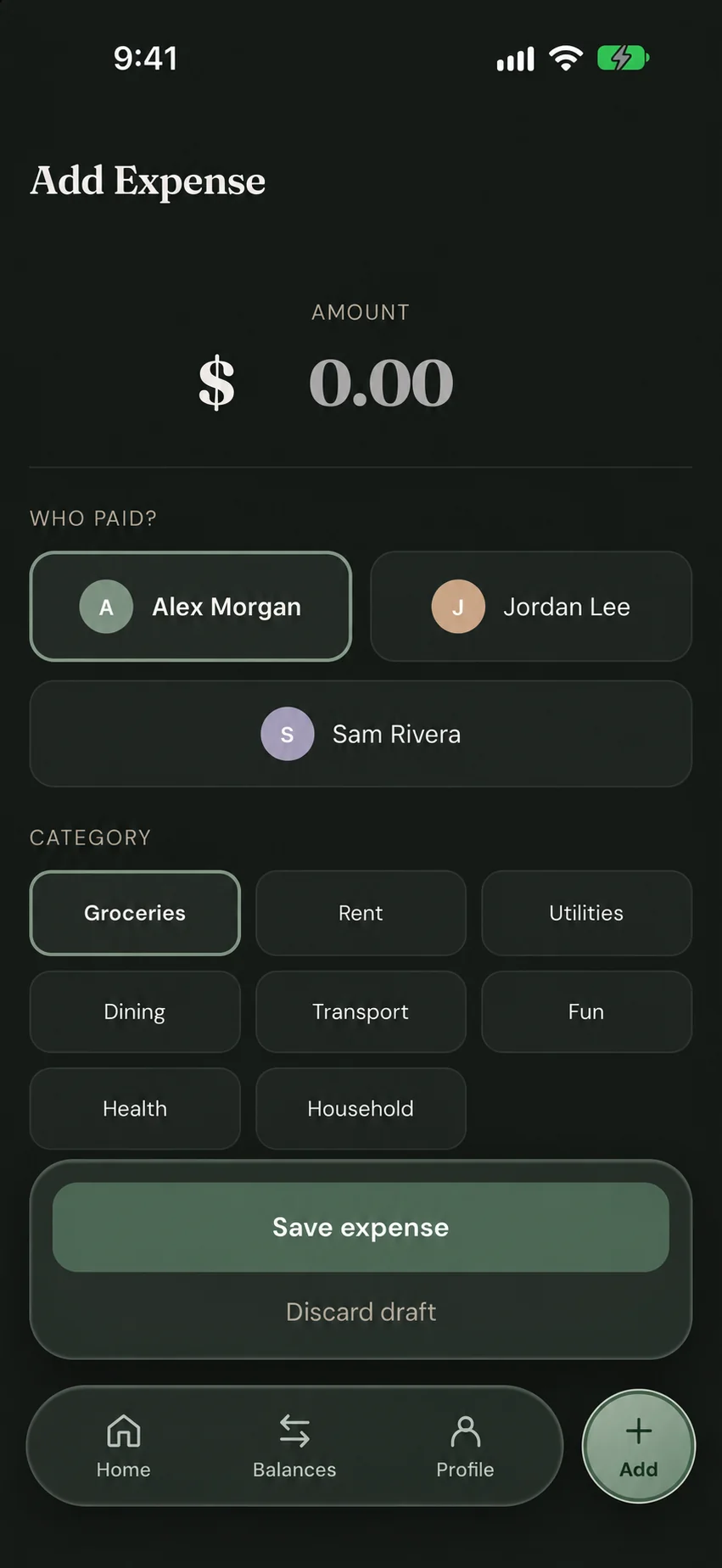
- Record shared expenses and who paid. FairTally applies the saved default, with an option to change the split for an individual expense.
- Check balances together and record settlements after arranging payment.
What if you each pay different bills?
Keep the same $1,800 total and 2 : 1 agreement. Alex pays $1,400 of the shared bills and Jordan pays the other $400. Before any settlement:
| Partner | Agreed share | Already paid | Balance |
|---|---|---|---|
| Alex | $1,200 | $1,400 | Is owed $200 |
| Jordan | $600 | $400 | Owes $200 |
Jordan pays Alex $200, bringing their net contributions to $1,200 and $600. Record each original bill with the correct payer; then record the $200 as a settlement after payment. A settlement is not another shared expense.
Read the step-by-step guide to saved splits and balances for the exact controls and examples. The saved ratio handles allocation; you still record each expense.
When your income or responsibilities change
Agree on when a new split starts
If Jordan’s take-home pay rises from $2,000 to $3,000 while Alex’s stays at $4,000, their income ratio becomes 4 : 3. Decide together whether to use that ratio and from which bill or month. Review existing records separately instead of assuming a new default will rewrite your history.
Keep personal purchases separate
If your shared grocery shop includes a personal purchase, record only the agreed shared amount as a household expense. If you normally split household bills 2 : 1 but agree to split a particular dinner equally, use Add Expense → Change split → Equal for that dinner.
Make room for unpaid work
Time spent caring for a partner, running the home, or taking leave may be part of your agreement even when it does not appear on a payslip. Write down the arrangement you both accept, including when you will revisit it. The formula compares money; it does not decide what each partner’s contribution is worth.
Common questions about splitting bills as a couple
Does earning twice as much mean paying twice as much?
Under a strictly income-based split, yes: incomes of $4,000 and $2,000 produce a 2 : 1 ratio. That is one option to compare, not a rule your relationship has to follow.
Do we need a joint bank account or to share our incomes in the app?
No. FairTally records expenses and who paid without bank linking. You can agree on a ratio privately and enter just those weights into the app.
What if one partner currently has no income?
A proportional calculation assigns them 0%. If that matches your agreement, use Percentage and enter 100 and 0 beside the correct partners. Check the split on each expense before saving. You can choose a different arrangement together.
Try the numbers without an account
The free calculator runs in your browser. It does not send entered incomes to a server or save them in browser storage. Copying a result puts it on your clipboard only when you select Copy split.
The FairTally app is separate: it uses an account to keep a shared household expense record. No bank linking is required. You can enter an agreed ratio without entering incomes into the app.
Sharing bills with more than two people? See the guide for throuples and polycules for a three-person example with different payers.
Keep your agreement in everyday use
Try every feature free for 14 days.
Choose web, iOS, or Android. New households get full access for 14 days from creation, with no credit card required.
One subscription covers up to 10 household members: US$5.99/month or US$49.99/year. After the trial, view-only access stays free; subscribe to keep adding and editing expenses.
See pricing and trial detailsPrices shown in USD. Store prices may vary by region; confirm the price and terms before purchase.